My favorite law book is Evidence in Action by Justice Pronove. It's funny because I discovered that law book when I was almost out of school, and only a few months before graduation. It's actually not the typical hard-bound and heavy book used in law schools - it's more of a primer and contains less than 300 pages.
What I liked about Evidence in Action is that it has discussed the most important matters about evidence in the simplest way. It's also very helpful on teaching students and new lawyers on how objections are made during litigation.
I know it's both hard and scary to say your very first "Objection, you honor." in court. But reading Evidence in Action has taught me how and when to object. It's a very friendly book and it cost me a little over $10. It's a little book that every law student and lawyer must own.
Sunday, April 21, 2013
Thursday, April 11, 2013
Congratulations to the New UM Lawyers
The University of Mindanao has produced 6 new lawyers in 2013, namely:
Atty. Myla Luna
Atty. Janer Sanchez
Atty. April Mitchor
Atty. Alnessa Thea Repollo-Uy
Atty. Ronnie Bulotano
Atty. Zacharias Catulong
Congratulations!
A total of 32 new lawyers from Davao City passed the 2012 Bar Examinations. For a complete list of passers, please go to this link.
On April 12, 2012, the Integrated Bar of the Philippines Davao City will be holding an oathtaking of the new lawyers in Davao City as well as the induction of the new set of chapter officers. The venue for this event will be at The Ritz Hotel, Garden Oases, Porrsas Street, Bo. Obrero, Davao City.


Complete List of 2012 Philippine Bar Examination Passers
1. A JOSE- AGUSTIN, Karren
2. ABASTILLAS, Lemuel
3. ABERIN, Ma. Christine
4. ABES, Royce Nieville
5. ABRENZOSA, Cleofe
6. ABUAN, Ruby Ryza
7. ACEDO, Kristian Josef
8. ACORDA, Jacqueline
9. ACOSTA, Lourdes Mae
10. ACOSTA, JR., Gil
2. ABASTILLAS, Lemuel
3. ABERIN, Ma. Christine
4. ABES, Royce Nieville
5. ABRENZOSA, Cleofe
6. ABUAN, Ruby Ryza
7. ACEDO, Kristian Josef
8. ACORDA, Jacqueline
9. ACOSTA, Lourdes Mae
10. ACOSTA, JR., Gil
Tuesday, April 09, 2013
Learning skills improvement
Education is the thing we should urgently pay attention to. Nowadays it is a problem, as a level of education becomes lower every year, and there are different reasons for this phenomenon: the teachers’ qualifications, the level of the educational institution, the parents’ education etc. However, one of the main factors that determines the degradation is the pupils’ reluctance to study. Parents should work with their children and try to help them to improve their learning skills. However, not only pupils should deal with the learning skills improvement. We study during the whole life, and well-developed learning skills will stand you in good stead. This task is real to succeed, you just need to know some information I want to share with you.
First of all, a pupil or a student should be conscious of what he wants to improve; he should have the so-called “learning strategies” to facilitate the process of learning skills improvement. Before doing it, students should take into consideration the following factors:
Develop different techniques of study. Well-developed reading skills can help you to find the necessary information easily and quickly, the ability to make clear notes helps you to understand the information better; developed review techniques help you to keep the learnt material fresh in your memory. It is obvious, that if you develop only one aspect, it won't do you good.
Paul Smith works at http://essaywritingservice.co/. He is an interesting person, amusing interlocutor and good educator. It is a great pleasure for him to meet new people and make new acquaintance.
First of all, a pupil or a student should be conscious of what he wants to improve; he should have the so-called “learning strategies” to facilitate the process of learning skills improvement. Before doing it, students should take into consideration the following factors:
- Capacity to learn;
- Interest in what he learns;
- What do you need?
- Where you can use the attained knowledge?
- What skills and habits you need to improve?
Develop different techniques of study. Well-developed reading skills can help you to find the necessary information easily and quickly, the ability to make clear notes helps you to understand the information better; developed review techniques help you to keep the learnt material fresh in your memory. It is obvious, that if you develop only one aspect, it won't do you good.
Your working place should be organized in the manner most appropriate for you. You should think about the light, noise, comfort etc. Moreover, start your work when you get everything you need for your study. Start your work with the most difficult one. In this way your brain will be fresh, and the task will be completed properly. It is recommended to do frequent breaks, your brain also need to have a rest, it will surely improve your learning ability and you will return to work with a fresh look and won’t be afraid of the difficult
homework. Train your memory, point out all the important information or you can even use the flash cards to remind you everything you need to remember. There are a lot of different games and techniques, so just choose one, which is good for you and learn with pleasure.
Some psychological moments should be mentioned here. Make sure you get enough sleep, otherwise your organism is tired and don’t have any desire to study. Finally, develop a positive attitude to the learning process. Turn your study into an exciting travel to the country of knowledge. Be sure, education is necessary in the modern world, especially if you want to live a good life and be able to teach your own children. Remember, that good education is your future and you should work hard to be a professional and have a successful career. It is a real chance to build up worthy future with great opportunities.
Paul Smith works at http://essaywritingservice.co/. He is an interesting person, amusing interlocutor and good educator. It is a great pleasure for him to meet new people and make new acquaintance.
Monday, March 11, 2013
Criminal Defense
When you have received a criminal complaint against you, don't take it lightly. The best thing that you can do is to hire a lawyer who will explain to you the nature of your charges. Be honest with your lawyer, he can plan you defense and guide you in all the processes of trial.
Hiring a defense attorney might be cumbersome for some people. A lot do not like dealing with attorneys because they think that having a lawyer is expensive. Yes, hiring a lawyer comes with a price. But how much do you value your freedom? You cannot just sit around and wait for a verdict that would put you to jail just because you did not have a good defense.
Finding a lawyer is relatively easy. Take for example, if you need a lawyer in a certain area, you can search the internet, say for example, Criminal Defense Attorney Georgetown Texas, and the list of law firms and lawyers will be enumerated on the page. But who among these firms and lawyers are you going to choose?
All lawyers are board certified, of course, one cannot practice without passing the bar examination. But not all lawyers have the experience. Choose one with the experience in the field. If you need a defense attorney, choose a lawyer who has a good reputation in criminal defense and who has actually gone to court to personally defend his clients. And most of all, you need to ask around. Ask you friends, family, and relatives, they will only recommend good lawyers for you.
Wednesday, February 20, 2013
Judicial Affidavit Sample
With all the buzz going around about Judicial Affidavits, lawyers and law office staff have been scrambling to find where they could get samples of the Judicial Affidavit.
Here's how I do it:
The full version includes the Attestation Clause.
Want a free version? Click here and leave me a comment below with your email address.
Here's how I do it:
Judicial Affidavit Sample by swexie
The full version includes the Attestation Clause.
Want a free version? Click here and leave me a comment below with your email address.
Wednesday, February 13, 2013
Legal Translation and the Legal Profession
The implementation of the Judicial Affidavit Rule which took effect on January 1, 2013 has required lawyers to prepare the judicial affidavit of their witnesses which shall be in the language known to the witness and, if not in English, it must be accompanied by translation in English or in the official national language of the country.
Legal translation service may not be very common to us lawyers here in the Philippines because the translation is traditionally done in open court, during hearings, by no less than the government-employed court interpreter. But with the advent of the new rule requiring the lawyers to prepare the direct examinations in written form, there is a need for them to learn or avail of legal translation services that would help them to properly translate answers given to them in the local dialect or other language other than English.
Back in college, I have observed from the court once that the judge asked the English translation of singkamas when the witness mentioned it during his testimony. The court interpreter was at a loss of words and doesn't seem to know the translation. But the judge said that it is "turnip." I didn't know that! So what if your witness is one of the people from indigenous tribes, or one who speaks his local dialect that you don't know of? I'm sure that you will need professional legal translation services for you to finish your judicial affidavit on time.
If you are looking for professional legal translators who could help you translate your affidavits, contracts, depositions, and other documents, you might want to check out Linguistic Systems Inc. which has been serving the legal community since 1967 with their translation and interpreting services.
Monday, January 28, 2013
What is the difference between questions of law and questions of fact?
Knowing the difference between questions of law and questions of facts is very important. The kind of question that a lawyer would want to raise before the Court of Appeals or the Supreme Court would determine the kind of pleadings and manner of filing.
A distinction between questions of law and questions of fact may not be defined by our rules of procedure or by our laws. However, our jurisprudence has the answer to our query. Read on.
In Republic of the Philippines v. Malabanan, this Court distinguished a question of law from a question of fact. A question of law arises when there is doubt as to what the law is on a certain state of facts, while there is a question of fact when the doubt arises as to the truth or falsity of the alleged facts. For a question to be one of law, the same must not involve an examination of the probative value of the evidence presented by the litigants or any of them. The resolution of the issue must rest solely on what the law provides on the given set of circumstances. Once it is clear that the issue invites a review of the evidence presented, the question posed is one of fact. Thus, the test of whether a question is one of law or of fact is not the appellation given to such question by the party raising the same; rather, it is whether the appellate court can determine the issue raised without reviewing or evaluating the evidence, in which case, it is a question of law; otherwise it is a question of fact.
A distinction between questions of law and questions of fact may not be defined by our rules of procedure or by our laws. However, our jurisprudence has the answer to our query. Read on.
G.R. No. 190994
September 7, 2011
TONGONAN HOLDINGSand DEVELOPMENTCORPORATION, Petitioner
- versus -
ATTY. FRANCISCO ESCAÑO, JR., Respondent.
In Republic of the Philippines v. Malabanan, this Court distinguished a question of law from a question of fact. A question of law arises when there is doubt as to what the law is on a certain state of facts, while there is a question of fact when the doubt arises as to the truth or falsity of the alleged facts. For a question to be one of law, the same must not involve an examination of the probative value of the evidence presented by the litigants or any of them. The resolution of the issue must rest solely on what the law provides on the given set of circumstances. Once it is clear that the issue invites a review of the evidence presented, the question posed is one of fact. Thus, the test of whether a question is one of law or of fact is not the appellation given to such question by the party raising the same; rather, it is whether the appellate court can determine the issue raised without reviewing or evaluating the evidence, in which case, it is a question of law; otherwise it is a question of fact.
What is the difference between Rule 45 and Rule 65?
A common question between law students and law practitioners alike, "What is the difference between Rule 45 (Petition for Review on Certiorari) and Rule 65 (Certiorari)?"
G.R. No. 168394
October 6, 2008
AGRARIAN REFORM BENEFICIARIES ASSOCIATION (ARBA), represented by JOSEPHINE B. OMICTIN,petitioner,
vs.
LORETO G. NICOLAS and OLIMPIO CRUZ, respondents.
Before We rule on the issues, there is a need to discuss the propriety of petitioner's appeal. As aptly indicated in its pleading, this is a petition for review under Rule 45 of the Rules of Court. However, a perusal of the errors ascribed by petitioner to the CA shows that they all pertain to allegations of abuse of discretion. In fact, petitioner clearly stated that "all three errors constitute abuse of discretion amounting to lack or in excess of jurisdiction."
This Court has consistently elaborated on the difference between Rule 45 and 65 petitions. A petition for review oncertiorari under Rule 45 is an ordinary appeal. It is a continuation of the case from the CA, Sandiganbayan, RTC, or other courts. The petition must only raise questions of law which must be distinctly set forth and discussed.
A petition for certiorari under Rule 65 is an original action. It seeks to correct errors of jurisdiction. An error of jurisdiction is one in which the act complained of was issued by the court, officer, or quasi-judicial body without or in excess of jurisdiction, or with grave abuse of discretion which is tantamount to lack of or in excess of jurisdiction. The purpose of the remedy of certiorari is to annul void proceedings; prevent unlawful and oppressive exercise of legal authority; and provide for a fair and orderly administration of justice.
Applying the foregoing, errors in the appreciation of evidence may only be reviewed by appeal and not by certioraribecause they do not involve any jurisdictional ground. Likewise, errors of law do not involve jurisdiction and may only be corrected by ordinary appeal.
Monday, December 03, 2012
December 12 is International Day Against Trafficking

Above is a snapshot I took from the Hall of Justice today. It's good to know that the forum we conducted in several public schools are in time for the commemoration of the International Day Against Human Trafficking this coming December 12, 2012.
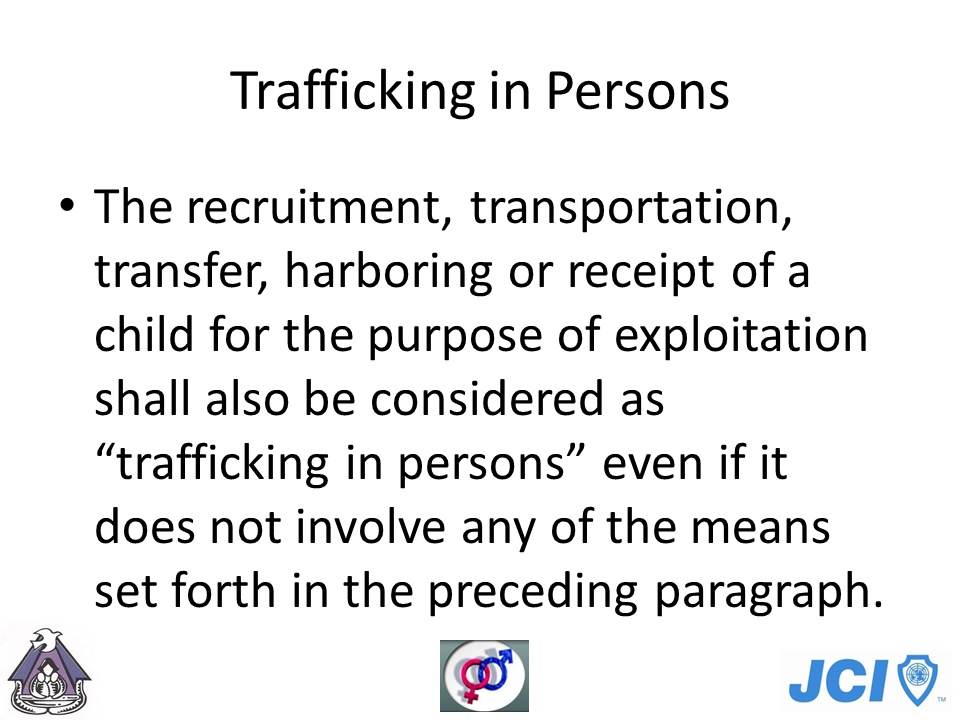
Let me share with you some slides from my presentation concerning the Anti-Trafficking Law:
What do you mean by TRAFFICKING IN PERSONS?

What are the ACTS OF TRAFFICKING IN PERSONS?


How can we PROSECUTE TRAFFICKING IN PERSONS?

Subscribe to:
Posts (Atom)