Pages

Wednesday, February 20, 2013

Judicial Affidavit Sample

With all the buzz going around about Judicial Affidavits, lawyers and law office staff have been scrambling to find where they could get samples of the Judicial Affidavit.

Here's how I do it:


The full version includes the Attestation Clause.

Want a free version? Click here and leave me a comment below with your email address.

Wednesday, February 13, 2013

Legal Translation and the Legal Profession

The implementation of the Judicial Affidavit Rule which took effect on January 1, 2013 has required  lawyers to prepare the judicial affidavit of their witnesses which shall  be in the language known to the witness and, if not in English, it must be accompanied by translation in English or in the official national language of the country.

Legal translation service may not be very common to us lawyers here in the Philippines because the translation is traditionally done in open court, during hearings, by no less than the government-employed court interpreter. But with the advent of the new rule requiring the lawyers to prepare the direct examinations in written form, there is a need for them to learn or avail of legal translation services that would help them to properly translate answers given to them in the local dialect or other language other than English.

Back in college, I have observed from the court once that the judge asked the English translation of singkamas when the witness mentioned it during his testimony. The court interpreter was at a loss of words and doesn't seem to know the translation. But the judge said that it is "turnip." I didn't know that! So what if your witness is one of the people from indigenous tribes, or one who speaks his local dialect that you don't know of? I'm sure that you will need professional legal translation services for you to finish your judicial affidavit on time.

If you are looking for professional legal translators who could help you translate your affidavits, contracts, depositions, and other documents, you might want to check out Linguistic Systems Inc. which has been serving the legal community since 1967 with their translation and interpreting services.

Monday, January 28, 2013

What is the difference between questions of law and questions of fact?

Knowing the difference between questions of law and questions of facts is very important. The kind of question that a lawyer would want to raise before the Court of Appeals or the Supreme Court would determine the kind of pleadings and manner of filing.

A distinction between questions of law and questions of fact may not be defined by our rules of procedure or by our laws. However, our jurisprudence has the answer to our query. Read on.


G.R. No. 190994 
September 7, 2011

TONGONAN HOLDINGSand DEVELOPMENTCORPORATION, Petitioner

- versus -

ATTY. FRANCISCO ESCAÑO, JR., Respondent.


In Republic of the Philippines v. Malabanan, this Court distinguished a question of law from a question of fact. A question of law arises when there is doubt as to what the law is on a certain state of facts, while there is a question of fact when the doubt arises as to the truth or falsity of the alleged facts. For a question to be one of law, the same must not involve an examination of the probative value of the evidence presented by the litigants or any of them. The resolution of the issue must rest solely on what the law provides on the given set of circumstances. Once it is clear that the issue invites a review of the evidence presented, the question posed is one of fact. Thus, the test of whether a question is one of law or of fact is not the appellation given to such question by the party raising the same; rather, it is whether the appellate court can determine the issue raised without reviewing or evaluating the evidence, in which case, it is a question of law; otherwise it is a question of fact.

What is the difference between Rule 45 and Rule 65?

A common question between law students and law practitioners alike, "What is the difference between Rule 45 (Petition for Review on Certiorari) and Rule 65 (Certiorari)?"


G.R. No. 168394             

October 6, 2008

AGRARIAN REFORM BENEFICIARIES ASSOCIATION (ARBA), represented by JOSEPHINE B. OMICTIN,petitioner, 

vs.


LORETO G. NICOLAS and OLIMPIO CRUZ, respondents.


Before We rule on the issues, there is a need to discuss the propriety of petitioner's appeal. As aptly indicated in its pleading, this is a petition for review under Rule 45 of the Rules of Court. However, a perusal of the errors ascribed by petitioner to the CA shows that they all pertain to allegations of abuse of discretion. In fact, petitioner clearly stated that "all three errors constitute abuse of discretion amounting to lack or in excess of jurisdiction."

This Court has consistently elaborated on the difference between Rule 45 and 65 petitions. A petition for review oncertiorari under Rule 45 is an ordinary appeal. It is a continuation of the case from the CA, Sandiganbayan, RTC, or other courts. The petition must only raise questions of law which must be distinctly set forth and discussed.

A petition for certiorari under Rule 65 is an original action. It seeks to correct errors of jurisdiction. An error of jurisdiction is one in which the act complained of was issued by the court, officer, or quasi-judicial body without or in excess of jurisdiction, or with grave abuse of discretion which is tantamount to lack of or in excess of jurisdiction. The purpose of the remedy of certiorari is to annul void proceedings; prevent unlawful and oppressive exercise of legal authority; and provide for a fair and orderly administration of justice.

Applying the foregoing, errors in the appreciation of evidence may only be reviewed by appeal and not by certioraribecause they do not involve any jurisdictional ground. Likewise, errors of law do not involve jurisdiction and may only be corrected by ordinary appeal.

Monday, December 03, 2012

December 12 is International Day Against Trafficking


Above is a snapshot I took from the Hall of Justice today. It's good to know that the forum we conducted in several public schools are in time for the commemoration of the International Day Against Human Trafficking this coming December 12, 2012.

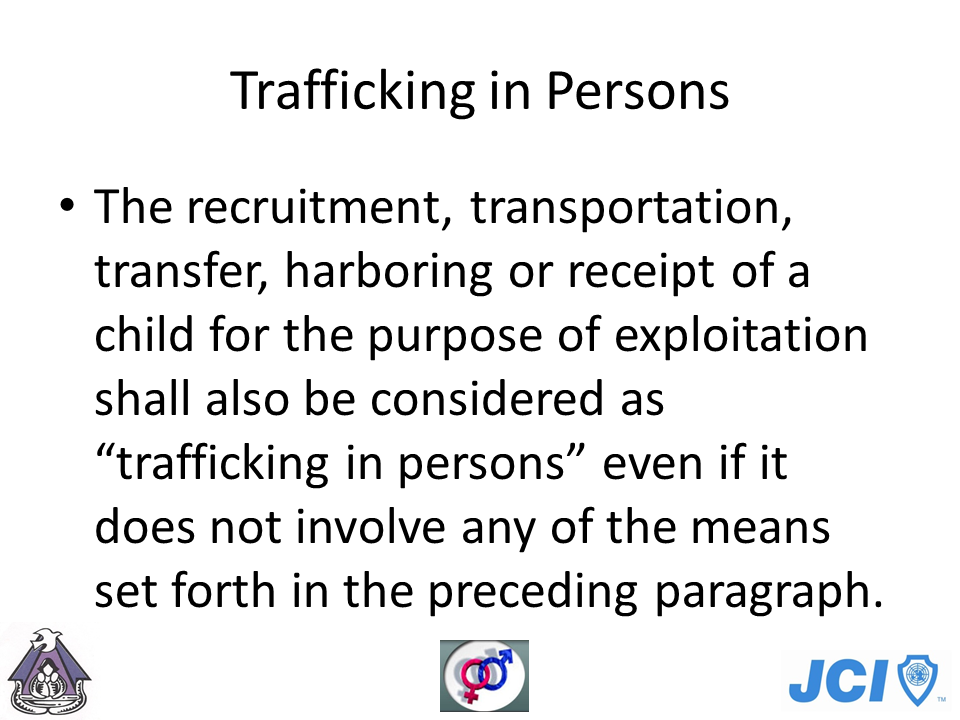
Let me share with you some slides from my presentation concerning the Anti-Trafficking Law:

What do you mean by TRAFFICKING IN PERSONS?


What are the ACTS OF TRAFFICKING IN PERSONS?


How can we PROSECUTE TRAFFICKING IN PERSONS?

Monday, November 26, 2012

Forum on Sexual Harassment, Rape, Trafficking in Persons, and Violence Against Women and their Children

The Luna Legal Resources for Women and Children, Inc., in cooperation with the Integrated Gender Development Division of the City of Davao and JCI Duwaling, Inc. has been conducting a series of fora on sexual harassment, rape, trafficking in persons, and violence against women and their children.

The fora were held at the different public schools all over Davao City with the following schedules:


November 20, 2012 – Wangan National High School, Calinan, Davao City; 1:00 – 4:30 PM
November 21, 2012 – Bernardo Carpio National High School, Buhangin, Davao City; 1:00 – 4:30 PM
November 22, 2012 – Cabantian National High School, Cabantian, Davao City; 1:00 – 4:30 PM
November 23, 2012 – Ramos National High School, Lanang, Davao City; 1:00 – 4:30 PM
November 27, 2012 – Doña Carmen National High School, Toril, Davao City; 1:00 – 4:30 PM
November 28, 2012 – Piedad National High School, Toril, Davao City; 1:00 – 4:30 PM


Fifty (50) student-leaders, from the mentioned schools were pre-selected to join the forum. Members of the Integrated Bar of the Philippines - Davao City Chapter were invited to conduct the said forum, among them are: Atty. Suzette Balucanag; Atty. Adolf Ryan Lantion; Atty. Chilette Escovilla; and Atty. Elisa Lapiña, all of whom are products of the University of Mindanao College of Law.

Wednesday, November 21, 2012

Review Notes: Contracts

Here are some of my notes taken down during my bar review. These notes are not meant to replace reading your textbooks but will only be a supplement to your readings. Nothing beats reading the codal provisions, text books, and jurisprudence.

These notes focus on Article 1306, the liberty of contracts as well as the principle of mutuality.

Unconscionable interest rates may be declared void for being contrary to morals.

In Union Growers Inc. case: Circular No. 905 of the Bangko Sentral ng Pilipinas allows contracting parties to stipulate the rates of interest.

There is no absolute liberty. Stipulations must not be contrary to law, morals, good customs, public order, or public policy.

In relation to Article 2035, what may not be compromised:

  1. civil status of persons
  2. validity of a marriage or legal separation
  3. ground for legal separation
  4. future support
  5. the jurisdiction of course
  6. future legitime
Non-involvement clause could be declared void depending on the circumstances. If the non-involvement clause is all-encompassing as to constitute restraint of trade, it is contrary to public policy.

Mutuality of contracts (Article 1308). Parties may agree to waive certain rights as long as the waiver is not contrary to law, morals, public policy, etc.

Article 1347 in relation to Article 905 on Future Inheritance: No contract may be entered into upon future inheritance except in cases expressly authorized by law.

GSIS Case. Facts: construction of house; bad bargain; asking for additional payment because of increase in the cost of construction materials but the contract did not provide an escalation clause. SC: contractor is not entitled to additional payment.

Security Bank Case. Facts: construction of building and contract provided for an escalation clause. SC: parties are bound by the principle of mutuality of contracts. Security Bank must PAY.

Article 311 Relativity of Contracts = binding effect of contracts.

What is stipulation pour autrui? A stipulation in favor of third persons, not parties to the instrument.

How are contracts perfected? Give examples of each of them. (Article 1315 and 1316)
Contracts are perfected depending upon their nature. Consensual contracts are perfected by mere consent, such as contract of sale. Real contracts, such as commodatum, are perfected until the delivery of the object of the obligation. 

Naguiat vs CA. Payment of a check is not equivalent to delivery. Contract of mutuum is not perfected until the proceeds of the check have been encashed. It only constitutes consensual agreement to lend money at a future time.

When is there consent? When there is meeting of the minds as to the object and cause or consideration.

Consent may be proven by evidence aliunde.

Object must be definite, determinate, and within the commerce of man.

Cause or consideration is presumed (Article 1354)

Article 1354 in relation to Article 1479 (Options): Is the consideration distinct from the price? Is it always in the form of money?

Answer: Read Serra vs. Court of Appeals and RCBC of Sorsogon. The stipulation whereby the building shall be transferred to the lessor int he case the lessee does not exercise the option to buy is the consideration of the option. Therefore, a consideration may be an undertaking, distinct from the price.

In Sanchez vs Rigos, no money, undertaking, or anything of value was given, the offer was simply accepted. The offer may be withdraw anytime prior to the exercise of the option because there's no consideration distinct from the price.


That's it for now. I suggest you read the full text of the jurisprudence mentioned.

Tuesday, November 06, 2012

Safety Issues: What's in my medicine? (Propyphenazone and Phenylpropanolamine)

Today, I bought Saridon from Mercury Drug at P 4.50 per tablet. I asked if there are any other medicines with Propyphenazone but the pharmacists could not give me any. Saridon is a drug available in the Philippines over-the-counter. When you say over-the-counter, it means that pharmacies can dispense the drug without the need of doctor's prescription.


An article in Sunstar Cebu has questioned the safety of Saridon, and more specifically, the safety of one of its main ingredients, Propyphenazone. The issue presented on the mentioned article boils down on how Prophyphenazone is banned in some countries while it is allowed in the Philippines with seemingly low to no dispensing restrictions, and on how medicines should be restricted on specific cases.

Saridon is not the only drug in the Philippines with Propyphenazone. Propyphenazone is mainly used to relieve pain and fever and is made a component of drugs due to its fast onset of action. With Propyphenazone, a drug takes effect in as little as 15 minutes. According to The Filipino Doctor, Propyphenazone acts quickly but also loses its effect quickly, so it complements Paracetamol, which takes effect slowly but has a longer lasting effect.

Propyphenazone, along with most if not all drugs, has contraindications, side effects and adverse drug reactions. They drug's dosage, which was listed by Mims Drug Information System at .5 to upto 1g up to 4 times daily for adults could readily tell us that the the amount of Propyhenazone in Saridon (which is only 150 mg per tablet) is way lower than the recommended dosage. Personally, I believe that the content of Propyhenazone in Saridon does not pose serious risk unless of course if the drug is taken in large doses for long periods of time, or if the drug is taken by people who are not supposed to take it like pregnant women and children.

The banning of Propyphenazone in some countries creates a lot of stir and would make us question why these medicines are not restricted for Filipino consumption.

On the other hand, Phenylpropanolamine is strictly regulated in the United States, was withdrawn in the Canadian Market, and banned in India. In 2010, the USA Food and Drugs Administration took steps to remove Phenylpropanolamine-containing medicines in the market, which then moved drug companies in reformulating these medicines. Phenylpropanolamine is an ingredient of Sinutab Extra Strength, which is also available in our country as an over-the-counter medicine.

With all these information placing us in a limbo, I can't help but question if there is a specific person or office which should clear these issues, and some more issues on medicines which have not even been brought up online. In my conversation with a certain doctor, I was told that the regulation of drugs is generally the function of ourFood and Drugs Administration (formerly Bureau of Food and Drugs or BFAD). Being the the guiding authority in this matter, it is only proper that our government agency should take the necessary measure in regulating drugs and ensuring that proper information about drug and medicine use would reach our kababayans. Our FDA is even mandated to monitor product advertisements and promotions to ensure that they comply with the existing laws.

We Filipinos are so fond of self-medicating. We don't go to doctors specially in the simple case of cough and colds and we would directly go to the nearest botika to buy what's available to relieve us of our ailments. In light of all the issues surrounding the laxity in dispensing our drugs, we must always take caution in buying and taking medicines.

Second Semester of Law School Begins

How's your first semester? I hope that law school has been treating you right. Most students have received or seen their first sem grades by now. I'm pretty sure that getting even just a passing grade of 75% would make a law student jump for joy.

What if I failed on a subject in law school?

Failing is not the end of the world. So you flunked, you can take the subject again. But if you flunked more than one subject in one semester, I think it would be best to ask yourself first whether or not you're still interested in the course. Studying law is not a walk in the part and you have to remember that this is not just law school, it's also an investment. Every law student should instill in his brain that going to school for 3 hours (or more) everyday to attend the classes is unlike going to your elementary or high school classes. Remember that you enrolled in law school because you want to become a lawyer. You might have other reasons for enrolling but bear in mind that it's pointless to study law if you don't have that ultimate goal of becoming an A-T-T-Y.

Set your priorities right. You might say that it's good to study with a group of friends, one we commonly call as group studying. But is it really productive? Some people love to study in groups because it helps them cope with boredom. Sure, you can chat with your pals when you're fed up with your books, but do you monitor the amount of time you spend talking with your friends compared to the amount of time you spend on reading? Personally, group study is not as efficient as having your one-on-one time with your books. It's boring, right, but the assimilation of lessons are best done when you're not dividing your attention and focus between books and the latest gossip. Also, there is absolutely no group work in the bar examinations. Keep your friends close, they will help you preserve your sanity. But keep them at a distance during the time of study.

Make up your mind. If you're into law school because you're pressured to do it, then evaluate your self and think about what you really want. It wouldn't help you a single bit if you're not happy with what you do. Imagine yourself 5 or 10 years from now. If you think that being in law school will help you or will make you the person that you want to become in the future, then continue your studies. If it's otherwise, then I think it's better to stop that spend 4 years of wasting your life in a road that you don't even want to walk through.

Good luck on second sem!

Wednesday, October 24, 2012

October 2012 Bar Examination

The mechanics for the October 2012 Bar Examinations have been changed and for the first time, barristers will be subjected to both Multiple Choice and Essay questions per subject.

I've heard some complaints after the first Sunday, mostly about how lengthy the examinations were and the lack of time to finish the two sets of questions. There were 100 multiple choice questions per subject. There were 10 sets of essay questions with at least 2 sub-questions for each set. I wonder if I'd be able to finish all of those in 4 hours.

Barristers were allowed to take home their questionnaires for this year's bar examination. I think that it would be a bad idea to read those questions again. I'd say, just throw it away. Anyway, you can download the questionnaires later from the Supreme Court website.

Questionnaires from the first three Sundays are already posted at the SC website.